This is the story of my maternal grandfather, but it could just as easily be your grandfather, great-uncle, brother or cousin.
This is the story of a young man who heeded a call to help his country in time of need; it is about a young man whose bravery not only impacted his life, but the lives of future generations.
Claude was born on a September Tuesday in 1895. Despite a thunderstorm the night before, Claude was born into a drought stricken city on the ancient and traditional lands of the Dharug people. It was a time when Australia was building its way into the history books of the world as a new colony of Mother England. And it was a time when the last convict had arrived twenty-seven years earlier and the Great Depression was still thirty-four years away.
The separate colonies that made up Australia in 1895 would be united as a federated nation by the time Claude reached his sixth birthday in 1901. The changes that Federation brought to the land of his birth would significantly impact Claude’s life by the time he reached the age of majority. Who could have predicted that Claude would celebrate his twenty-first birthday in a war on the other side of the world, under conditions no man should have to endure, let alone one who was too young to vote but old enough to enlist?
Enlistment was expected, but safe return was not guaranteed.
William Richard Augustus Sneesby was born in October 1892 and had at least reached the age of majority by the time of his enlistment in August 1915. Nineteen year old Claude followed his older brother’s lead three months later. The boys were originally assigned to different battalions, but eventually both served in the 45th Battalion.
How would a mother of two fine young men feel as she waved them off to war, knowing she might never see them again? Emily Beatrice, mother of Claude and William, would have had mixed emotions as each of her boys set off to serve in the 1914-1918 war.
Leaving parents and friends behind would have been hard enough for William and Claude, but to say goodbye to a cherished seventeen-year-old sister and nine-year-old brother would have been even harder. Enlistment was expected, but safe return was not guaranteed.
Claude left an unfinished apprenticeship as a plumber, and William left his employment as a plasterer. Perhaps because of his talent as a trumpeter in the Lidcombe Band, Claude was assigned the task of Bugler in the 13th Battalion, while William joined the 7th Regiment.
They were not giants of men, but they were brave and loyal. Both William and Claude measured up at five feet three inches on enlistment; their expanded chest measurements were between 31 and 35 inches, and both were in the vicinity of 120-130 pounds in weight. Claude was described as dark complexion, black hair and brown eyes, while William had a fair complexion, dark hair and brown eyes.
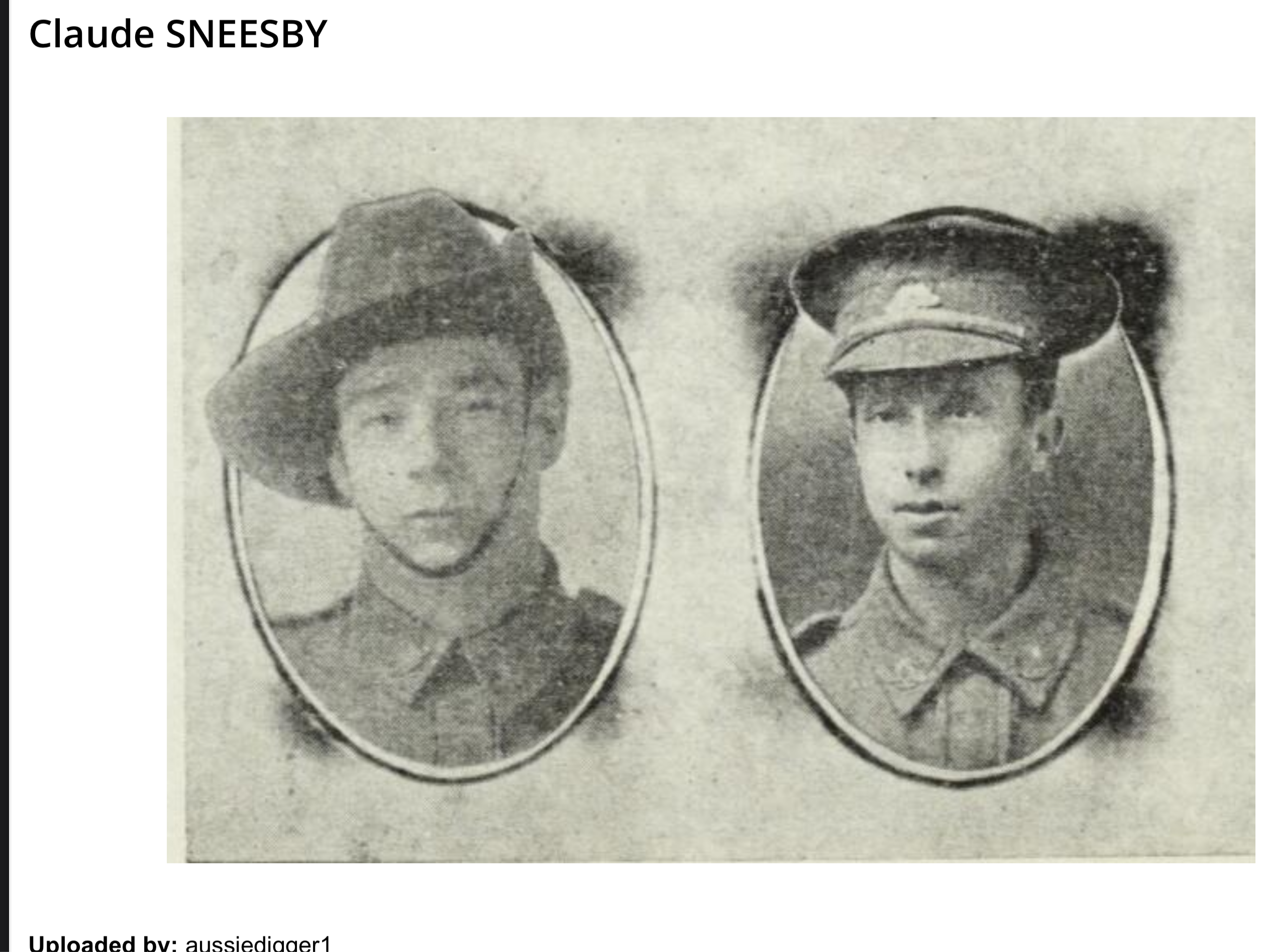
In 1914, the mandated minimum height for enlistment in Australia was 5 feet 6 inches. In June 1915, the height requirement dropped to 5 feet 2 inches, which opened the way for Claude to enlist after his nineteenth birthday, and possibly explains why William had not enlisted the year before. Many of those who had been deemed ineligible in 1914 were readily signed up in 1915 as height, age and other restrictions were eased.
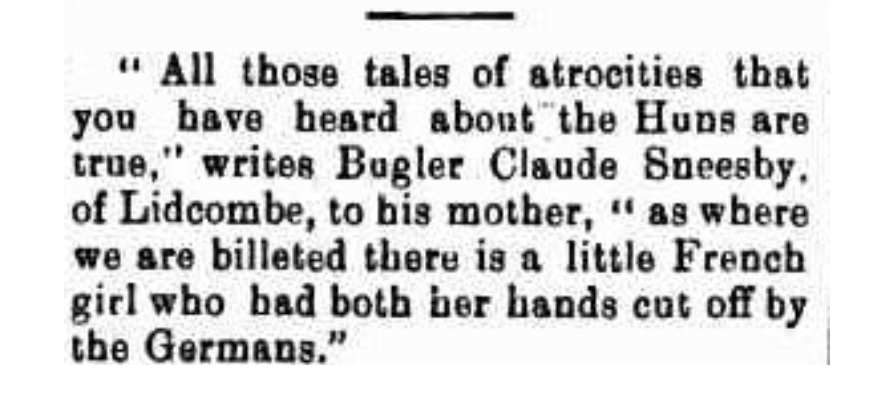
To say war was hell would be a gross understatement, if the letters Claude wrote home are anything to go by. In 1916, Claude wrote:
Life in the trenches is well documented. We’ve read of the cold and wet, mud and disease, and what our Anzacs had to do just to survive. An enterprising Claude, and his mate, found a way to make their digs a little more comfortable.
On the 9th November 1916 Claude wrote to his former employers, Messrs Brown and Childs. He addressed his letter as from ‘The Gables‘. After describing his recent respite on Lemnos Island, Claude wrote of how he was back in the thick of the fighting, but added, “hardly a shot is fired all day and very few at night…”, at least from the position he was in. Claude went on to describe the dug-out he and his carpenter mate shared, complete with ‘gable roof’ made of waterproof sheets, and cozy blankets. Such enterprising young lads must have been an asset to their former employers. Claude wished his employers and fellow work-mates a Merry Christmas and Happy New Year, but signed off with “Hope to see you before next Christmas comes round”. Claude would see that Christmas and the next one on the battlefields, before arriving home just before the Christmas of 1918.
In September 1916, Claude’s letter home was published in a Sydney newspaper. He wrote about having met up with Ted Kingsley, the son of the local mayor, who had enlisted at just sixteen years of age. Claude described Ted as a ‘snifter little fighter‘. Ted survived the war and was returned safely to his hometown, a little older, and probably a lot wiser.
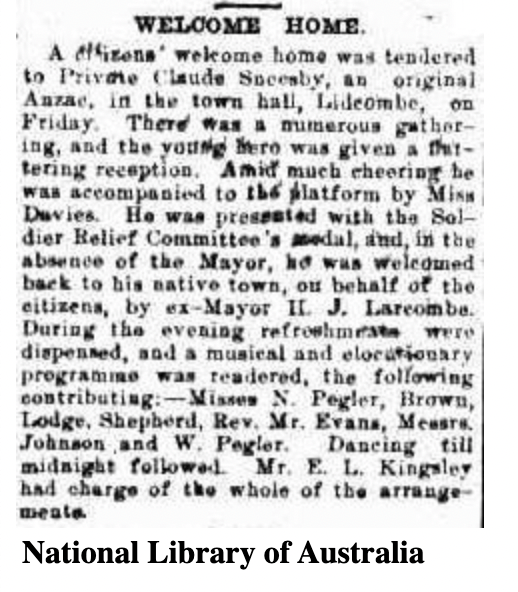
… welcomed back to his native town, on behalf of the citizens …
On the 7th December, Claude arrived safely home to his family and friends in Lidcombe. A car was provided to transport Claude and his family from the railway station to the family home. As the car passed the school where Claude had been educated, students lined the footpath on each side of the street to welcome him home. The Headmaster had arranged for current students to show their gratitude to a former student who had served his country.
Two weeks later Claude attended a dance held in his honour in the Lidcombe Town Hall.
Claude wasn’t awarded a Victoria Cross or any other distinguished medal for his service, nor is his service written up in any history books as being anything but ordinary, but Claude was a hero. He was as much a hero as every other Anzac who saw the war from the inside of a muddy, cold, wet trench. They thought nothing of boarding a troop ship to sail to places they probably hadn’t dreamed of, or perhaps even heard of, when the call to war from Mother England reached Australian shores.
Beatrice was one of the lucky mothers who waved a teary goodbye to her sons on their departure, and gave a thankful embrace on their return. Claude resumed his apprenticeship as a plumber, but went on to drive buses in Sydney and Bankstown.
William and Claude met, and married, beautiful young women. They became fathers, grandfathers and great-grandfathers. Claude was affectionately known as Gramps to his grandchildren and great-grandchildren and was loved by them all, as well as by his many nieces and nephews. It was a very sad day in their lives when their beloved Gramps passed away in October 1975.
He was more than just a common soldier…
Claude Ernest Claise Sneesby was, and always will be, their hero.
References:
(RETURNED ANZAC. (1918, December 7). The Cumberland Argus and Fruitgrowers Advocate (Parramatta, NSW : 1888 – 1950), p. 2. Retrieved August 18, 2022, from http://nla.gov.au/nla.news-article86212068).
Attrocities-in-France, Grenfell Record and Lachlan District Advertiser (NSW : 1876 – 1951), Tuesday 22 August 1916, page 4.
Australian War Memorial https://www.awm.gov.au/articles/encyclopedia/enlistment#:~:text=First%20World%20War,chest%20measurement%20of%2034%20inches.
The Cumberland Argus and Fruitgrowers Advocate (Parramatta, NSW : 1888 – 1950), 21 Dec.1918, Welcome Home, nla.gov.au/nla.news-article86212229
(transcript): Welcome Home. A citizens’ welcome home was tendered to Private Claude Sneesby, an original Anzac, in the town hall, Lidcombe, on Friday. There was a numerous gathering, and the young hero was given a flattering reception. Amid much cheering he was accompanied to the platform by Miss Davies. He was presented with the Soldier Relief Committee’s medal, and, in the absence of the Mayor, he was welcomed back to his native town, on behalf of the citizens, by ex-Mayor H. J. Larcombe. During the evening refreshments were dispensed, and a musical and elocutionary programme was rendered, the following contributed:- Misses N. Pegler, Brown, Lodge, Shepherd, Rev. Mr. Evans, Messrs. Johnson and W. Pegler. Dancing till midnight followed. Mr. F. L. Kingsley had charge of the whole of the arrangements. (National Library of Australia http://nla.gov.au/nla.news-article86212229).
 The Family History Vault