From a tough beginning,
to a role in Australia’s Defence Force.

Dawn Service – Anzac Day
2021
Audrey was born in Waipu on the north island of New Zealand, in 1923. It could have been an idyllic life if her father, Arnold Hart, hadn’t died suddenly when she was eleven months old. Audrey’s Australian-born, widowed mother could not manage the family’s kauri farm with one baby and another on the way, so she returned to Australia to the support of her extended family. When they arrived in Australia, and for reasons she will probably never understand, Audrey was handed to her mother’s older sister to raise.
“She was a strict old thing … “
Audrey Powell, Interview, 10 March 2022.
In an interview on 10 March 2022, Audrey mentioned more than once that her aunt was a “strict old thing“. Despite the strict upbringing, Audrey was given a good education and a seemingly comfortable life. The Methodist Ladies College (MLC) in the Sydney suburb of Burwood was, and probably still is, an elite school, and it was at MLC that Audrey was educated.
When asked what her first job was when she left school, Audrey replied, “I didn’t have one … I just rode my horses“.
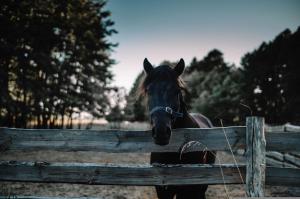
Audrey’s love of horses, and comfortable lifestyle, may have compensated for the losses in her early life: the loss of her father when she was too young to remember; growing up in a different household to her mother and sister; living in the care of her strict aunt.
World events changed lives
In her teenage years Audrey’s social life centred around the Red Cross Younger Set, and her involvement was reported in Sydney newspapers under her birth name – Audrey Hart.
In 1939, Audrey’s world began to change. World War II had begun and Australia was quick to defend its shores against Japan, as well as involvement in conflicts in Europe, the Mediterranean and North Africa.
“You know, everything was topsy-turvy and all the boys were going away: this one had gone; that one had gone; someone else was in uniform …”.
Thousands of men and women enlisted, and most subsequently left Australia for war zones.
“…all the girls that I knew started to drift off to the … Forces. One went to the Army, a couple went to the Air Force. You know, they were all sort of doing that …“.
As Audrey’s social world was shrinking, her thoughts turned to what she could do to help her country with the war effort, and to reconnect with her dwindling social network.
“Well, I was getting sort of itchy feet because everyone was joining; … so we sort of, drifted off. I don’t know why, but I just appeared in a place down in Sydney where you signed in…” (recruitment office).
Audrey explained how she turned up at a recruitment office and enlisted in The Women’s Auxiliary Australian Air Force (WAAAF) at the age of about twenty (unsure of exact age…).
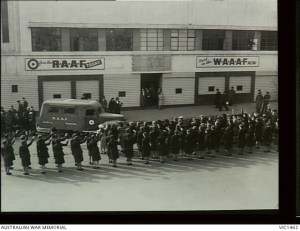
Image from Australian War Memorial
Unlike Britain, Australia didn’t call for National Service for single women, but Australian women were quick to volunteer. Prior to enlistment, Audrey enrolled in a Morse Code course at Fort Street Girl’s High School in Sydney. On enlistment, her Morse Code training channelled her into the mustering of Signaller in the WAAAF.
“… we had to get out 60 words per minute… We knew it was about planes: coming; going; expecting; but we didn’t know [details] because it was in code.”.
Why the Air Force?
When asked why she had chosen the Air Force, Audrey replied,
“I don’t know why, it just sounded good so I thought, oh yes, that’ll do“.
The issue of a uniform posed a problem for the petite Audrey, who had to wait while a custom-sized uniform was made for her. She described how this made her feel “left out“.
“… we were given a big sack”
When asked about the issue of beds, Audrey laughed.
“Well the first thing we did, we were given a big sack, and told to go over to that shed and fill it up with straw. And that was our bed, that was the mattress“.
Audrey described how everything had to be folded up each morning, ready for inspection. When asked how long it took to learn how to do that, Audrey’s instant response was “Very quickly, because we had inspections!,” (she laughed).
“That’s not right, and that’s not right” (Audrey mimicked the sergeant), “… we just were in hysterics half the time“, she said.
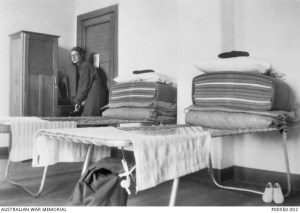
It doesn’t take long when talking to Audrey to realise that her longevity is probably due to her incredibly positive attitude. Even when speaking about her time in the WAAAF during the war, Audrey described the camaraderie and friendships, rather than the hardships. Almost apologetically she confessed that she loved her time in the WAAAF. Was it because of being raised essentially as an only child by an elderly aunt? Audrey somewhat flippantly remarked “I might have wanted to get away from her”.
Perhaps being sent to a training site at Ascot Vale next to Flemington in Melbourne was half the fun. “We got into the races for free“, Audrey added, with a cheeky laugh. The Melbourne Cup at Flemington is the signature Australian horse-race in November each year, so there is little wonder that that experience would feature prominently in Audrey’s memory.
There’s something about a sailor…
During her childhood, Audrey met the man she would eventually marry. Their paths crossed many times before they met again in Melbourne during the war years. Keith was an Officer in the Royal Australian Navy (RAN), and Audrey wore the (specially made) uniform of the WAAAF. This time the meeting was different.
When Audrey and Keith first met as children, Keith introduced himself by giving Audrey a Chinese burn, and was mortified when she screamed her obvious disapproval (he apparently thought he’d killed her).
There were no Chinese burns when they met again in Melbourne. When they were out together in uniform, Audrey’s colleagues would walk past them numerous times, just to have Keith return their salute. He was obviously a good-looking man, especially in his naval uniform.
In 1944, Audrey and Keith married in Sydney. Keith continued his career in the RAN, but when Audrey was expecting their first child, her Air Force career ended, as was mandated at that time, and for many years later.
Choices for women were very different back then. Many workplaces dictated that women must cease employment as soon as they married. Because of the demand for labour with so many men away, married women were permitted to stay on in the WAAAF during the war years, but not if they became pregnant. Audrey left the WAAAF to embark on her new career as wife and mother. When the war ended and women were no longer needed to replace men in essential jobs, most employers returned to the mandate that a woman had to cease employment when she married, which remained in place until the 1960s for Public Servants.
The sound of Joy Bells
On the day Audrey’s first child was born in 1945, church bells across towns and cities rang out to signify the end of the war. Audrey gave her daughter the middle-name of Joy, in honour of the joy bells she heard on the way to the hospital that day.
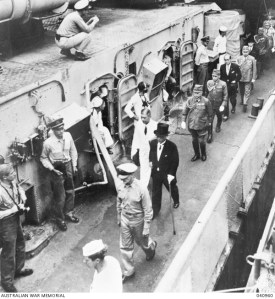
Keith was in Tokyo Bay in Japan on 2 September 1945, when the Japanese signed their surrender onboard the USS Missouri. Keith was part of the nine allied nations who witnessed the signing.
The war was finally over.
Ninety-nine years young
Four children and numerous grandchildren and great-grandchildren later, Audrey lives comfortably in a picturesque, small town in northern New South Wales. She has lived a productive and full life, only leaving the independence of her own home at the end of 2019 when she moved into a supported-living unit. Her two daughters live nearby and ensure that Audrey’s social life is as full as she has the energy to sustain. At ninety-nine years young, Audrey is amazingly well and agile, and is no stranger to the restaurants and retail stores of Murwillumbah.
Before Covid-19 restrictions, Audrey could be found in the community-centre participating in an exercise class, or a game of mahjong. She has only recently (reluctantly) agreed to use a wheeled-walker for assistance, but only when it is absolutely necessary.
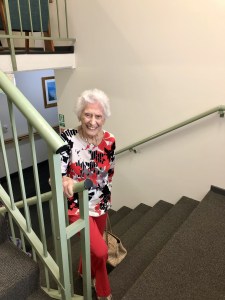
When Audrey was interviewed on 10 March 2022, she was vibrant and in full control of facts recalled from more than three-quarters of a century ago. At the end of an hour the oral historian started to wind up the interview, but Audrey kept going. Her energy and recall were befitting someone a lot younger than her ninety-nine years. The oral historian left the interview in need of rest; Audrey left the interview for a lunch-date with her daughters. To say she is amazing, and an inspiration, is a gross understatement. Audrey personifies ageing-well: independent; relatively agile; engaged in her community.
Audrey Powell
WAAAF
Service No. 109615
1939-1945
Audrey served with pride,
and her service will be remembered, honoured, and appreciated.
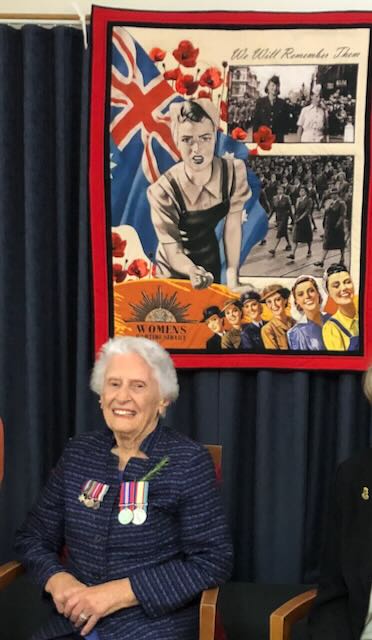
Audrey Powell,
we thank you for your service.
Other Posts
102 Candles and a Bailey’s: Celebrating Betty Sneesby
Today, she would have celebrated her 102nd birthday. I imagine she would have raised a Bailey’s to toast another milestone year, joked with family about ‘getting older’, and still outrun her great-grandchildren in a race across the park. On the 10th January, 1924, Betty Sneesby was born. Perhaps being the firstborn to her parents, Ruby…

Stepping Stones To Family History
On a recent trip to Perth, Western Australia, I was fascinated by the sequence of dates immortalised on the footpaths within the Central Business District, so I started paying more attention. The first date I photographed was my birth year (no, not the ones featured below), followed by the birth years of significant others in…
Annie’s Life – Defined by a Vowel
In the English language there are five vowels: a – e – i – o – u Lots of words begin with a vowel, but probably none more feared, in our not too distant past, than the word illegitimate. The Cambridge Dictionary defines illegitimate as “born of parents not married to each other“. In Australia, in the late…
Light a Candle
… Not because it is dark, but because it’s what you do in a church, at least in the church I attended. I was raised Catholic, with a few quirky bits around the edge. My paternal grandmother was very Catholic – my dad – well – that’s a long story. My paternal grandmother, the granddaughter…
Something went wrong. Please refresh the page and/or try again.
Follow Me…
Get new content delivered directly to your inbox.
 The Family History Vault