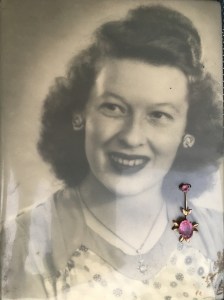
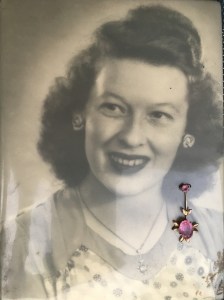
Today, she would have celebrated her 102nd birthday.
I imagine she would have raised a Bailey’s to toast another milestone year, joked with family about ‘getting older’, and still outrun her great-grandchildren in a race across the park.
On the 10th January, 1924, Betty Sneesby was born. Perhaps being the firstborn to her parents, Ruby and Claude, made her somewhat special: a bit of a larrikin; a tomboy; a debutante. She was all of these in her younger days, but age didn’t diminish her willingness to have a go at anything, or to stand up for what was right.
Her father fought at Gallipoli in the Great War of 1914. As a trumpeter in the Lidcombe band, he was assigned the role of Bugler in battle. When the war ended, Claude became an accomplished boxer. Perhaps it was his way of releasing some of the horrors he had seen in the trenches on the other side of the world.
Claude taught his daughter the finer points of defending herself and anyone else who found themselves on the wrong side of local bullies.
Despite her fearless approach to life, Betty could just as easily don a ballgown and be the belle of the ball, or tap dance with a local dance troupe to entertain soldiers. During the war that was never meant to be, following the war that was “meant to end all wars1“, Betty was engaged to a young soldier, whom she married on the 29th January, 1944.
World War II
Tommy Berg was so handsome with his blonde hair and blue eyes, it was easy to see how the beautiful young Betty could fall in love with him. War may have separated them while Tommy fought with the Australian Army in New Guinea, but peace brought them together again when the guns were finally silenced.
Many years and five children later, Tommy succumbed to a terminal illness in March 1995. Betty continued on, just as she had when faced with any hardship throughout her life. Always the life of the party, and always with the love of her children, grandchildren, and eventually great-grandchildren at the centre of her universe.
And the tough years?
The early years were hard, but Betty never complained. She just got on with it.
Whether it was carting buckets of water to the chooks2 at the other end of the farm, or using a hessian bag soaked in water to beat flames threatening the house, she just did it.
After Tommy’s death, Betty stayed in their home on the northern side of Brisbane, where they had migrated to from Sydney years earlier. Surrounded by friends and family, Betty engaged in a rigorous social life, often dictated by wherever the like-minded seniors of the Crazy Gang were meeting for coffee that day.
On the 11th November3, 2015, Betty left this earthly life to join her family and loved ones on the other side. It was a sad day for those left to mourn her, but a fate we must all one day face.
Betty’s Legacy
Betty raised a son and four daughters. Each one benefited from watching a strong woman deal with whatever a hard life threw at her.
Never afraid to stand up for what was right.
Never afraid to work hard.
And she never complained.
So today, we, the children of Betty Sneesby and Tommy Berg, celebrate the life of a remarkable woman, our mother.
We honour Betty by trying to live up to her standards in our own lives.
We honour Betty by telling our children and grandchildren about how strong their grandmother and great-grandmother was.
We honour Betty by never forgetting the sacrifices she made for all of us.
So, today we raise a toast to what would have been Betty’s 102nd birthday. And we know she will be kicking up a storm on that other side of life, still the life of the party, and still outrunning everyone.
In Australia, in the late nineteenth/early twentieth century, illegitimate was a word that had serious connotations. It wasn’t enough to say you were married when registering the birth of a child, you seemingly had to provide a date for the said marriage. If there was no marriage date, it was likely that the child was labelled ‘illegitimate’. Birth certificates in New South Wales were stamped accordingly, and the father’s name either not recorded on the document, or in my great-aunt’s case in 1898, recorded, then noted to be removed. She was given the label ‘illegitimate‘.
One can only wonder at the shame felt by women who, for various reasons, had a child out of wedlock, a situation frowned upon by society at the time. My great-aunt’s birth was no exception.
My great-grandmother, born Annie Siddall, 1879, in Sheffield, Yorkshire, bore her first child in Sydney New South Wales at the age of twenty. The father’s name was recorded on the birth document, despite a note in the margin instructing that it be removed. Luckily it wasn’t. The label on that birth certificate confirmed the parent’s marital status: ‘illegitimate‘, or born out of wedlock, as it was commonly called.
Annie, as I remember, was a quiet, elegant woman who died when I was six years old. I remember the day clearly. I remember the stairs leading up to her room in the flat she lived in with her daughter and son-in-law in Leichhardt, on the western side of Sydney. I still have some of Annie’s things, passed down to me from my mother: a watch, a sandalwood fan, but most of all, memories of a beautiful great-grandmother.
Only now, as an adult in a seemingly enlightened world, can I appreciate what Annie went through. It wasn’t enough that her first child was born out of wedlock, but her second child narrowly escaped entering the world with the same label.
A few years ago while researching Annie’s life, I stumbled across a newspaper article dated 1900, the year before my grandmother was born. It seems Annie was trying to locate the father of her first-born daughter, the older sister of my yet to be conceived grandmother. In desperation Annie went to the police, who issued a warrant for Daniel’s arrest: the charge – desertion of an illegitimate child. A year later another article appeared in the same newspaper, stating that the warrant for Daniel’s arrest had been withdrawn because he was going to marry Annie.
When my grandmother was born in September 1901, her birth registration included the marriage date of her parents, and excluded the label illegitimate, if only by the grace of four months from the date of the marriage. Daniel’s name took it’s rightful place as father of the child on the formal document.
Twelve months later Daniel was on the run again. In 1902 he married another woman, in another country, only to return a few years later to the suburb where he and Annie had lived. Daniel relocated his second family in close proximity to the one he had abandoned in 1901. A DNA match with a granddaughter from Daniel’s second family confirms that Daniel was indeed the father of my grandmother, from his first family.
Daniel’s subsequent clashes with the law can be found in the pages of Sydney newspapers through the wider-reaching lens of the Internet, which gives us access to those newspapers more than a hundred years after they were printed.
We will probably never know when Annie changed the course of her life, and that of her two young daughters, but we know that she did.
In 1912, Annie added another daughter to her family. A chance comment by my mother in her declining years caused a ripple effect through Annie’s descendants. Nonchalantly, over afternoon tea, my mother regaled the story of my cousin’s mother, Annie’s youngest daughter, being passed over the back fence for Annie to raise. Adoption meant there was no blood relationship between Annie and her youngest daughter, and therefore between the descendants of the three daughters.
When you grow up loving the cousins you know so well, it would take more than an adoption to sever the ties of those relationships, and so it is with my family. The children of Annie’s youngest daughter are just as much the cousins of the children of her first two daughters as they ever were, regardless of the lack of DNA or blood-connection.
Documents pertaining to children in care in New South Wales were recently digitised and released, and part of the adoption story emerged. Annie legally adopted her youngest daughter when the baby was nine months old. The records state the child’s birth-mother’s name, but no father was registered. The words ‘Deserted’, and ‘Illegitimate’ were recorded on what would become a vital document in the life story of an adopted daughter.
But there was another noteworthy piece of information on that baby’s adoption document. Annie’s and Daniel’s surnames did not match, nor did Annie use her maiden name. Instead, Annie’s surname was the same as Charles’ surname – the man the family had believed was Annie’s husband and the father of her three daughters. Research had already established, and proven, Annie’s marriage to Daniel and the paternity of their first two daughters, and the adoption of the third daughter, but when did Annie marry Charles?
No record has been found of a marriage between Annie and Charles. When Annie died in 1956 my grandfather, husband of Annie’s middle daughter, recorded the missing details on her death certificate. Annie’s surname was recorded as the same as Daniels, but also included that she was ‘also known as‘ Mrs … (the surname of Charles). The forethought of my grandfather to record the details accurately, illuminated the path going forward for descendants to see the whole picture of Annie’s life, albeit, missing details of when she co-habited with Charles, and why she didn’t marry him. Did Annie consider herself still married to Daniel, despite his subsequent marriage overseas? Did she always love the rebel Daniel? Sadly, we will never know, as those who may have held the knowledge have long since passed.
Does it matter that Annie and Charles didn’t marry? In the twenty-first century, while marriage is still popular, there are many who choose to have children and not marry until later, if at all.
Although too late for Annie and the women of her era, the boundaries of righteousness that dictated the order in which a woman should marry and conceive, have been stretched, and indeed removed. Men, in the old equation, were only held responsible for the financial support of the children they spawned, not their part in fathering an illegitimate child. The father’s name was not recorded on the birth registration if he had not married the mother prior to the child’s birth. Fathers were seemingly spared the shame and scorn that prevailed at the time; shame and scorn were reserved for the woman and child.
That previously feared word, illegitimate, no longer has the impact on a child’s life, or that of the child’s mother, that it did in our great-grandparents era. In Australia, broadly speaking, the expectation to marry before having children, or at all, is no longer valid (with the exception of some sub-cultures based on cultural or religious beliefs). The law in Australia has changed to extend the same legal rights to de facto relationships as married couples, allowing more moral freedom for all, especially women1.
And the word, illegitimate, has no place in our society now, nor should it ever have had2.
1 The view that the changes in law that allow more moral freedom for all, especially women, is the personal opinion of the author
2 The personal opinion of the author
Note: if you have any questions regarding the life of my great-grandmother, Annie Siddall, please contact me through this site, and I will respond.
Anecdotal Note: ***Information gleaned from the marriage certificate of Annie and Daniel suggests they were married at the World Matrimonial Association at 471 Pitt Street Sydney, not necessarily the Church of Latter Day Saints as implied on the certificate. The building housed a marriage business run by Theophilus Carulus. The following newspaper report from 1903 paints Mr Carulus as a somewhat less than favourable character. Annie’s marriage certificate was signed by Edith Carulus as a witness to the marriage.

 The Family History Vault