Stepping Stones To Family History

On a recent trip to Perth, Western Australia, I was fascinated by the sequence of dates immortalised on the footpaths within the Central Business District, so I started paying more attention.

The first date I photographed was my birth year (no, not the ones featured below), followed by the birth years of significant others in my life. I remember wondering if there was likely to be any relevance between the year and the name on the stone blocks, so I reached out to Google.

Ironically, the name on the paver of my birth year was F. E. Chamberlain, a union delegate who became the State Secretary of the Labor Party in Western Australia. I was flabbergasted: I was active in the Teachers Union throughout my career, and joined the Labor Party for a rather short-lived involvement in politics in the nineties. Falling asleep in a meeting after a long day in the classroom dampened my enthusiasm somewhat, and probably didn’t do much for the guest speaker’s confidence. But there it was – F E Chamberlain: union delegate and politician. I took that as a connection.

Since this site is my Family History Vault, I reached for the photo of my father’s birth year: 1922.
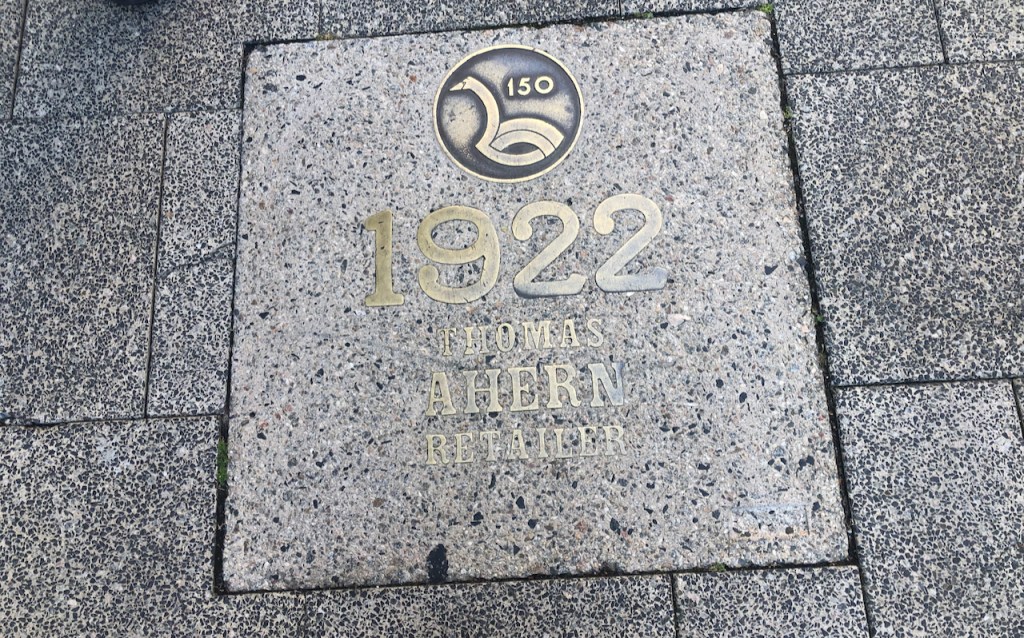
Brick paving block with the inscription 1922, Thomas Ahern, Retailer

The name and occupation on the paver is Thomas Ahern, Retailer. Dad did his share of retailing over the years as an insurance and car salesman when he wasn’t driving taxis, and he certainly kept a few clothing retailers in business. Dad’s taste in clothes and shoes leaned towards extravagant. Not the kind of extravagance of the wealthy, just the ordinary variety of a large family living within a tight budget.

There was an immediate connection between Dad and Thomas Ahern in their Christian names. Dad was christened Alfred Thomas Berg, but was known to everyone as Tom or Tommy. As I read through the account of Thomas Ahern’s life, I struggled to move on from the first few paragraphs; the account of his life before he arrived on Australian shores.

Thomas Ahern was born in Ireland, as were my father’s maternal ancestors. Thomas Ahern’s mother was Mary McGrath, and two of the places Thomas found employment were Kilkenny and Tipperary. Dad’s Irish great-grandparents, John Spencer and Catherine Grainger, were from Tipperary, and another great-grandmother, Catherine McGrath, was from Kilkenny.

The next significant block is 1924, the year of my mother’s birth.

Brick paving block with the inscription 1924, Phillip Collier, Premier.

Phillip Collier was born at Woodstock near Melbourne on 21 April 1873 and became Premier of Western Australia in 1924, the year my mother was born. Mum didn’t share Collier’s passion for politics, but she was just as determined to speak up for what was right and support anyone who needed help, albeit without the wages afforded to politicians. The name Collier is linked to our closest neighbours in the 1960s – brothers Nick and Bill Collier, although I doubt they were any relation to the illustrious Labor leader and Perth Premier Phillip Collier.

It seems even a long-overdue trip to Perth can become a genealogical stepping stone. Not because of a direct link to my family research, but because a few photos taken along the way can relate, even indirectly, to someone in my family tree. I only searched for the birth years of my closest relatives, but a more thorough investigation may have unearthed more interesting facts. .

I did spend a few hours in the State Library looking for clues to my Swedish Grandfather’s time in Kalgoorlie in the early 1900s, but I’m still no closer to any facts, so my search continues.
Translation

Oh, how much easier my life would be if my grandfather hadn’t left Sweden to make his home in Australia. If I’d been born in Sweden I would probably be at least bilingual, but sadly, I only speak English. That’s assuming I would have been born at all. I share my grandfather’s Swedish DNA, but also that of my Australian-born grandmother, who met and fell in love with my handsome Swedish grandfather and bore his ten children. If Grandfather had married a Swedish girl, in Sweden, would I have materialised into a Swedish version of who I am today?

But, Grandfather didn’t marry a Swedish girl, and he didn’t stay in Sweden. So here I am, a mere monolingual Aussie, trying desperately to translate the Swedish documents that tell of Grandfather’s other life, and therefore, the lives of my Swedish ancestors.

Being born in 1950 gives me a bit of an edge on the translation journey. My (then) teenaged children embraced technology in the eighties and shoved me head-first into the world of computers, so I am no stranger to the Internet and search engines in today’s modern world. And with the beauty of the Internet comes a diverse range of apps and websites that can solve a couple of monolingual problems.

  1. Learning a second language can be undertaken in the comfort of your own home via any number of apps.
    • Duolingo is just one of the apps available that is super-affordable, and a fantastic method of learning Swedish. Admittedly, I’m only up to the part where I could ask for a drink of water in Sweden, but I’m working on it.
  2. Most Swedish archival websites provide a handy little tab at the top that says ‘English‘., so I can select the English version of the page.
    • But, there are a lot of words on most documents that escape the translation parameters and therefore are stuck in Swedish.
  3. There are hundreds (possibly thousands) of websites that offer translation from one language to another.
    • This is my preferred method for expediency in translating documents since none of the Swedish documents I’ve found so far mention ‘drink of water’.
    • I type the Swedish word into the translator, and it gives me the English equivalent.
  4. A Swedish keyboard is available as an alternative when entering Swedish text.
    • Don’t ask me how I found it because I was born in 1950, and just remembering what I had for breakfast a few hours after the event is a mammoth challenge, so I can’t remember how or where I found the keyboard.
    • A Google search should help you locate the alternate keyboard, which can be easily accessed alongside the good old English keyboard used for everything else.
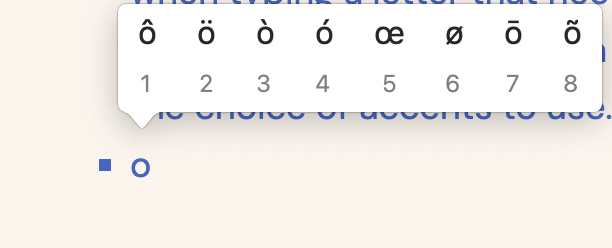
    • I accidentally found an easy way to toggle the Swedish keyboard (there’s a lot to be said for being a bit slow) on my trusty Mac laptop:
      • when typing a letter that needs a Swedish accent, like ö, I hold down the letter o until a little box pops up, giving the choice of accents to use.

I imagine the alternate keyboard idea works for other languages as well.

If future generations are reading this post they will no doubt chuckle at how quaint this all is. I imagine years from 2023 you are all microchipped at birth, right? There’ll be no need to search for DNA matches and old documents because everything you think, say or do will be embedded on the microchip the instant you think, say or do it, right? Heck, perhaps I’m getting a bit ahead of myself, but you get the picture, I’m sure.

So, when it comes to translation I reckon I’ve got a pretty good handle on it, albeit, cumbersome handle, back here in March 2023 (we haven’t been microchipped yet – that service is only available to our domesticated pets, oh, and some endangered wildlife). So, until we are microchipped I’ll continue to:

  • learn Swedish
  • select the ‘English’ tab on Swedish websites
  • seek out an online translation service website

And if all else fails, I’ll phone a Swedish neighbour, but I’ve avoided that step because most of my research is done way outside normal waking hours, as is the case with most family historians I suspect, so my translation needs will continue to be met online.