On a recent trip to Perth, Western Australia, I was fascinated by the sequence of dates immortalised on the footpaths within the Central Business District, so I started paying more attention.
The first date I photographed was my birth year (no, not the ones featured below), followed by the birth years of significant others in my life. I remember wondering if there was likely to be any relevance between the year and the name on the stone blocks, so I reached out to Google.
Ironically, the name on the paver of my birth year was F. E. Chamberlain, a union delegate who became the State Secretary of the Labor Party in Western Australia. I was flabbergasted: I was active in the Teachers Union throughout my career, and joined the Labor Party for a rather short-lived involvement in politics in the nineties. Falling asleep in a meeting after a long day in the classroom dampened my enthusiasm somewhat, and probably didn’t do much for the guest speaker’s confidence. But there it was – F E Chamberlain: union delegate and politician. I took that as a connection.
Since this site is my Family History Vault, I reached for the photo of my father’s birth year: 1922.
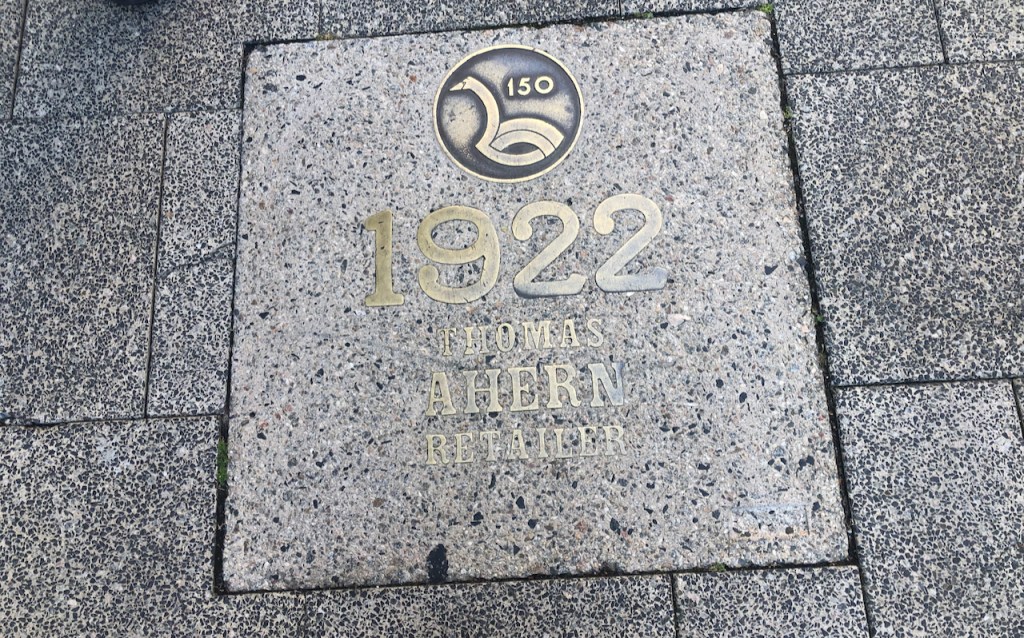
The name and occupation on the paver is Thomas Ahern, Retailer. Dad did his share of retailing over the years as an insurance and car salesman when he wasn’t driving taxis, and he certainly kept a few clothing retailers in business. Dad’s taste in clothes and shoes leaned towards extravagant. Not the kind of extravagance of the wealthy, just the ordinary variety of a large family living within a tight budget.
There was an immediate connection between Dad and Thomas Ahern in their Christian names. Dad was christened Alfred Thomas Berg, but was known to everyone as Tom or Tommy. As I read through the account of Thomas Ahern’s life, I struggled to move on from the first few paragraphs; the account of his life before he arrived on Australian shores.
Thomas Ahern was born in Ireland, as were my father’s maternal ancestors. Thomas Ahern’s mother was Mary McGrath, and two of the places Thomas found employment were Kilkenny and Tipperary. Dad’s Irish great-grandparents, John Spencer and Catherine Grainger, were from Tipperary, and another great-grandmother, Catherine McGrath, was from Kilkenny.
The next significant block is 1924, the year of my mother’s birth.

Phillip Collier was born at Woodstock near Melbourne on 21 April 1873 and became Premier of Western Australia in 1924, the year my mother was born. Mum didn’t share Collier’s passion for politics, but she was just as determined to speak up for what was right and support anyone who needed help, albeit without the wages afforded to politicians. The name Collier is linked to our closest neighbours in the 1960s – brothers Nick and Bill Collier, although I doubt they were any relation to the illustrious Labor leader and Perth Premier Phillip Collier.
It seems even a long-overdue trip to Perth can become a genealogical stepping stone. Not because of a direct link to my family research, but because a few photos taken along the way can relate, even indirectly, to someone in my family tree. I only searched for the birth years of my closest relatives, but a more thorough investigation may have unearthed more interesting facts. .
I did spend a few hours in the State Library looking for clues to my Swedish Grandfather’s time in Kalgoorlie in the early 1900s, but I’m still no closer to any facts, so my search continues.
 The Family History Vault